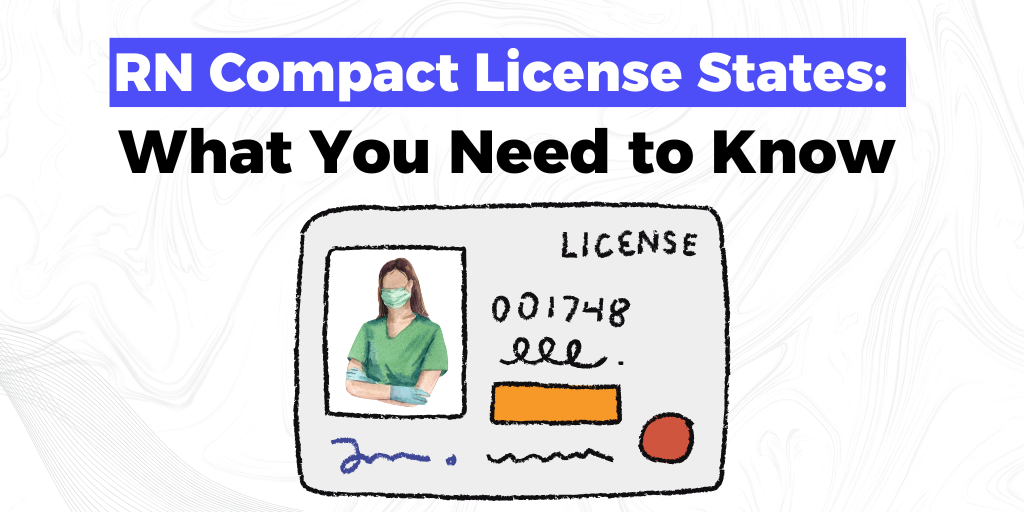
Hey nurses! Ever consider working in a another state without the headache of having to obtain a new license? The Nurse Licensure Compact (NLC) does just that, allowing both Registered Nurses (RNs) and Licensed Practical/Vocational Nurses (LPNs/LVNs) to practice across state borders, using only a single license.
This blog breaks down RN Compact License States: What You Need to Know, covering which states are in, which are out, why it matters, how to get started, and answers to your burning questions.
What’s the Nurse Licensure Compact (NLC)?
The NLC is like a driver’s license for nurses—it lets you work in multiple states without applying for a new license each time. It kicked off in 2000 and got an upgrade in 2018 as the Enhanced Nurse Licensure Compact (eNLC), adding tougher rules like background checks to keep things safe. It’s a game-changer for travel nursing, telehealth, or jumping in during emergencies. The nursing compact states 2023 list has grown a bit into 2025, with a few new states joining the party.
Which States Are Nursing Compact States?
As of 2025, 41 places are part of the eNLC, so with a multistate license, you can work in any of these without extra paperwork. Here’s the full list of which states are nursing compact states, with a quick note about each:
- Alabama: Joined in 2000, making it super easy for nurses to work across state lines.
- Arizona: Joined in 2002, a hot spot for travel nurses thanks to its healthcare needs.
- Arkansas: Joined in 2000, helping nurses serve rural clinics and hospitals.
- Colorado: Joined in 2007, great for nurses working in the Rocky Mountains.
- Connecticut: Signed up in May 2024, starts officially on October 1, 2025.
- Delaware: Joined in 2000, a big supporter of the NLC’s mission.
- Florida: Joined in 2018, perfect for travel nurses and telehealth gigs.
- Georgia: Joined in 2018, opening doors for nurses in the South.
- Guam: Partial member since 2021, lets multistate license holders practice but doesn’t issue them yet.
- Idaho: Joined in 2001, supporting nurses in rural Western areas.
- Indiana: Joined in 2020, one of the newer full members.
- Iowa: Joined in 2000, helping Midwest nurses move freely.
- Kansas: Joined in 2019, making rural healthcare more accessible.
- Kentucky: Joined in 2007, great for nurses working near Appalachia.
- Louisiana: Joined in 2019, handy for disaster response in hurricane-prone areas.
- Maine: Joined in 2000, supporting nurses in New England’s small towns.
- Maryland: Joined in 2000, a hub near D.C. for nurse mobility.
- Massachusetts: Signed up in November 2024, still getting ready to roll out by 2026.
- Mississippi: Joined in 2001, helping Gulf Coast healthcare.
- Missouri: Joined in 2000, a central spot for compact nursing.
- Montana: Joined in 2015, perfect for nurses in remote areas.
- Nebraska: Joined in 2001, boosting nurse access across the Great Plains.
- New Hampshire: Joined in 2006, supporting New England’s healthcare workforce.
- New Jersey: Partial member since 2019, allows multistate licenses but doesn’t issue them for residents yet.
- New Mexico: Joined in 2001, great for cross-border work.
- North Carolina: Joined in 2000, a key nursing hub in the Southeast.
- North Dakota: Joined in 2000, helping rural Upper Midwest communities.
- Ohio: Joined in 2023, expanding Midwest nursing opportunities.
- Oklahoma: Joined in 2018, supporting rural and tribal healthcare.
- Pennsylvania: Partial member since September 2023, full rollout coming July 7, 2025.
- Rhode Island: Joined in 2024, strengthening New England’s compact network.
- South Carolina: Joined in 2000, a leader in Southern nurse mobility.
- South Dakota: Joined in 2001, aiding rural healthcare access.
- Tennessee: Joined in 2000, a big player in Southern healthcare.
- Texas: Joined in 2000, one of the first and a travel nursing hotspot.
- U.S. Virgin Islands: Signed up in 2021, still awaiting full implementation.
- Utah: Joined in 2000, supporting nurses in the West.
- Vermont: Joined in 2022, helping rural New England healthcare.
- Virginia: Joined in 2005, key for D.C.-area nurses.
- Washington: Joined in 2024, expanding West Coast compact access.
- West Virginia: Joined in 2018, supporting Appalachian healthcare.
- Wisconsin: Joined in 2000, a Midwest compact leader.
- Wyoming: Joined in 2018, great for remote nursing practice.
Want a visual? Check out a nursing compact states 2026 map on the NCSBN website (updated for 2026). Newcomers like Connecticut and Massachusetts joined in 2026, and Pennsylvania’s partially in, so some nurses can use multistate licenses there already.
Which States Are Not Compact States for Nursing?
Some states haven’t jumped on the NLC bandwagon yet. Here’s the list of which states are not compact states for nursing:
- Alaska
- California
- District of Columbia
- Hawaii
- Illinois
- Michigan
- Minnesota
- Nevada
- New York
- Oregon
You’ll need a single-state license to work in these states. Places like California and New York are talking about joining, but it’s not happening yet. Moving to one of these? Be ready for extra paperwork and fees for licensure by endorsement.
Why Get a Compact Nursing License?
A multistate license is a big win for nurses. Here’s why:
- Work Anywhere (Almost): Practice in missouri nursing compact states, florida nursing compact states, or virginia nursing compact states without additional licenses. Great for travel nursing or telehealth.
- Save Money and Time: One license, fewer fees, less hassle.
- Help in Crises: Jump into disaster zones in tennessee nursing compact states or north carolina nursing compact states fast.
- Telehealth and Teaching: Work remotely or teach students in states like arizona nursing compact states or south carolina nursing compact states.
How to Get a Compact Nursing License
To score a multistate license, you need to meet these requirements:
- Live in a compact state (your Primary State of Residence, or PSOR).
- Graduate from a board-approved nursing program.
- Pass the NCLEX-RN or NCLEX-PN.
- Have an active, clean RN or LPN license.
- Pass federal and state fingerprint background checks.
- No felony convictions or nursing-related misdemeanors.
- Have a valid U.S. Social Security Number.
- Pass an English proficiency test (if you studied abroad).
Apply through your state’s nursing board. Check your status on Nursys (www.nursys.com). If you move to another compact state, get a new multistate license in your new PSOR within 60 days. For non-compact states, you’ll need a single-state license.
Things to Watch Out For
The NLC isn’t perfect. Here are some heads-ups:
- Follow Local Rules: Even with a multistate license, you’ve got to follow the laws of the state your patient’s in. Mississippi nursing compact states might differ from iowa nursing compact states.
- Non-Compact Challenges: States like California have held back due to concerns about standards. This impacts nurses in new mexico nursing compact states or delaware nursing license compact states working elsewhere.
- APRNs Don’t Qualify: The NLC is for RNs and LPNs/LVNs only. APRNs need the APRN Compact, which is less common.
Wrapping It Up
Knowing RN Compact License States: What You Need to Know can open doors for your nursing career. Whether you’re eyeing maryland nursing compact states, iowa nursing compact states, or south carolina nursing compact states, the NLC lets you work across borders with ease. Head to Nursys to check your license, reach out to your state board for a multistate application, and watch for updates on non-compact states like California. The NLC helps you make a bigger difference in healthcare, wherever you go.
FAQs
Q1 What states are members of the nursing compact?
ARIZONA NURSING LICENSE COMPACT STATES, FLORIDA NURSING LICENSE COMPACT STATES, VIRGINIA NURSING LICENSE COMPACT STATESA bout 41 places, the 41 places mentioned above. Check NCSBN for the latest.
Q2 What states are not compact states for nursing?
Alaska, California, New York and those other places up there. Others might join your miles soon keep a lookout.
Q3 Where may I view a nursing compact states 2025 map?
Head to www.nursecompact.com or www.ncsbn.org to see the map from which the above compact and non-compact regions are extracted.
Q: Can I take a job in Missouri or Mississippi, which are also nursing compact states?
Yes they are both eNLC states for nursing and these nursing multistate license helps here!
Q: Can I use my Delaware nursing license for compact states?
A: Yes, the Delaware nursing license compact states is completely eNLC, therefore, you can apply for a multistate license.
Q: How the NLC applies for Arizona or Arkansas for nursing license compact states?
A: Nursing compact: Arizona and Arkansas are participating states, this means that you can work there with a multistate license.
Q: What of compact states for nursing license in New Mexico or North Carolina?
A: They’re both eNLC, so you’re good.
Q: Can I practice in Tennessee or South Carolina compact nursing states?
A: Yes tennessee nursing compact states, and sc nursing license compact states are multistate licensure states.
Q: Are my Virginia or Wisconsin nursing license multistate?
A: You should be fine if global commission on internet governance You can’t live in South Dakota and itglobal commission on internet governance (eNLC).If you worked in a member state that wasn’t listed and applied for a holding license, youhad a multi-state license and confused the holder and the home state.. If you’re in one of the virginia nursing license compact states or wisconsin nursing license compact states, you should definitely double-check with your state board to make sure you actually applied for a multistate license.
Q: What are nursing compact states 2024 vs 2026?
A: The 2023 roster was smaller; Connecticut, Massachusetts and others followed or are in progress by 2026.